
Pressure growing on Helium supply
All the signs continue to point to rising Helium demand, with a series of recent news articles showing how the pressure is building.
Already crimped by war damaging helium production infrastructure in Qatar and Russia, AI demand and nuclear expansion are reported to be adding significant stress to Helium supply.
Analyst Akap Energy has done a deep dive into Helium demand models, and its latest report assesses the impact of its use in optical fibre manufacturing, which accounts for 7% of worldwide Helium consumption.
"(That) makes it one of the larger single end-uses after semiconductors, MRI, lifting gas and welding," Akap says.
Helium is used in two of the three stages of fibre production. Akap says fibre-to-the-home, 5G and future 6G backhaul, hyperscale data-centre interconnection and national digital-infrastructure programmes will force a surge in Helium use as more fibre is required.
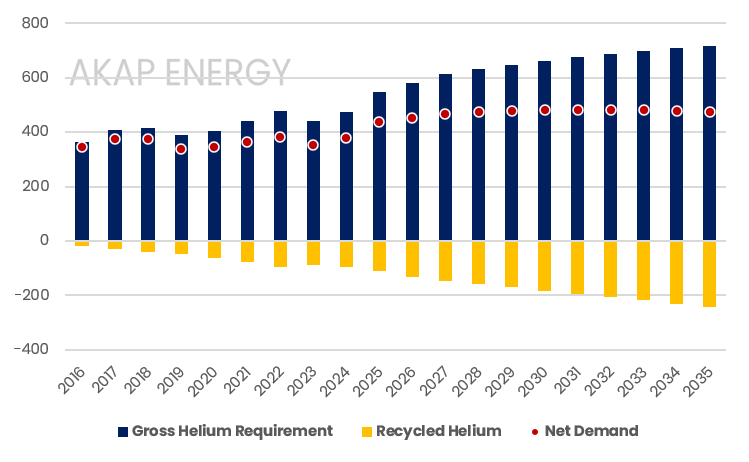
Akap sees Helium demand for fibre alone growing from 440 mmcf in 2025 to about 480 mmcf by 2030. Despite likely improvements in Helium recycling, "(This) is still a structural, non-substitutable source of demand and it remains exposed to Helium availability, purity requirements and price volatility."
The Akap assessment is here.
Helium demand in the fibre optics segment (mmcf)
Meanwhile, Akap also highlights a recent deal on nuclear fusion between the UK and the US, which aims to advance both countries’ efforts significantly. That story is here. Akap says:
"We believe that faster development enabled by such partnerships of superconducting magnets, cryogenic systems and prototype plants would broaden the long-term demand for Helium."
Another sign of Helium pressure problems came in a recent article in London’s FT, highlighting rising electricity demand from Chinese AI data centres.
Of 58 new conventional nuclear plants being built around the world, more than half are in China as it gears up to power the AI drive. The country is investing heavily in an emerging class of small modular reactors (SMRs), in which Helium can be used as the primary coolant.
Akap says of the news: "We believe growth in Helium-cooled SMRs, alongside expanding fusion development, is likely to increase Helium demand over the coming years."
The FT story is behind a paywall here, and Akap’s summary is here.
Gold Hydrogen, meanwhile, continues it’s testing campaign on South Australia’s Yorke Peninsula to prove it has commercial levels of Helium within its tenement.